Alarm Management
Alarm management is the effective management of alarm systems in process control systems (automated process control systems) aimed at reducing accident rates and, as a consequence, improving production efficiency.
We offer ALARM management services for organizing effective alarm system management at hazardous industrial facilities.

Management System
ISO 9001:2015
ID 9000012276
www.tuv.com
Alarm Management Implementation Services
Stage 1. Management System Implementation
Implementation of an alarm management system is possible on any process control system used in Russia at the design or operation stage of the facility and does not require additional software.
RBI Concept LLC is an expert organization in the field of optimal alarm management organization. Our experience is built on continuous practice, and the Alarm management process itself is based on the following Russian standards and international practices:
- GOST R IEC 62682-2019 Alarm Systems for the Process Industries;
- ANSI-ISA-18.2-2009 "Management of Alarm Systems for the Process Industries";
- EEMUA 191 "Alarm Systems A Guide to Design, Management and Procurement".
To organize effective alarm management, we offer a series of sequential steps:
- Demonstration of alarm management system advantages to company technical management;
- Preparation of enterprise standards (regulations, instructions) for Alarm Management;
- Formation and training of a permanently operating working group from the customer company's employees;
- Preparation and approval of alarm system implementation schedule;
- Plan implementation with reports on each completed facility or system;
- Preparation of monthly/quarterly reports demonstrating achievements: "before – after" at the "Operation" stage by the Alarm Management working group;
- Demonstration of key performance indicators (KPIs) for Alarm Management, linking facility managers to KPIs.
Expected dependency: the higher the KPI indicators, the safer and more efficient production will be.
Stage 2. Support (if necessary)
If required, our engineers will continue to provide technical and expert support for the alarm system, within the framework of the existing contract, after implementing this system at the customer's facility.
Additional activities:
-
Automation of alarm status reporting and its comparison with key indicators;
-
Implementation of dynamic and static alarm suppression systems, allowing the control room operator to make management decisions about the technological process faster.
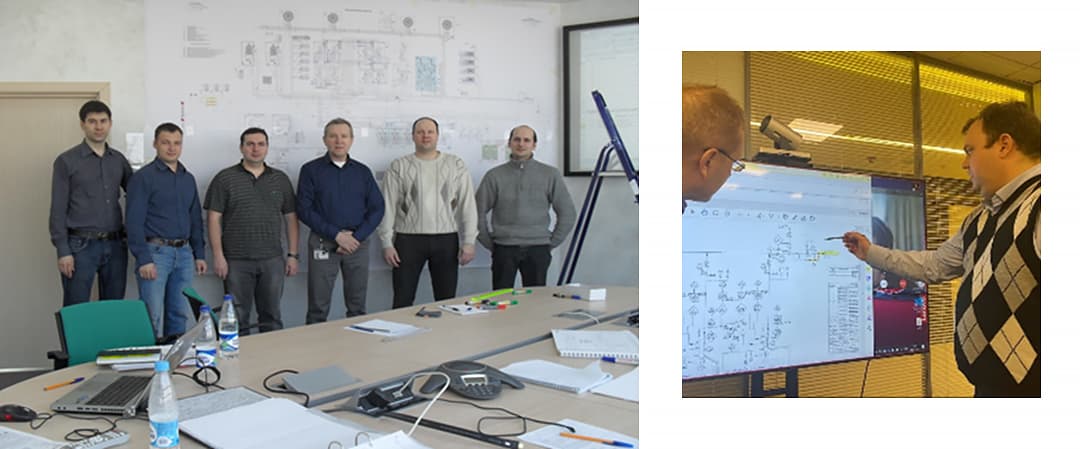
Group of engineers
Alarm Management
Alarm management is a system for improving the quality of alarm signal management and increasing the efficiency of process control system dispatchers.
With the development of new technologies and construction of large chemical, petrochemical, energy, and oil production enterprises, automated production control systems (process control systems) have found wide application. Considering the fragility of the environment, as well as high risks of accidents and man-made disasters at hazardous production facilities, additional control and management of equipment operation is carried out from dispatch centers, where all current information about process status and equipment condition converges. In "online" mode, the operator can change process parameters or stop it manually if necessary. To facilitate operators' work, alarm signals were added that inform the operator about deviations from set parameters and potential threats to the process, allowing necessary decisions to be made before activating process control systems or emergency shutdown systems, making the process smoother.
At large production facilities, the number of alarm alerts can reach tens or even hundreds of thousands. Managing such a volume of information coming to the control panel of the dispatch center is very difficult, and sometimes impossible. For example, up to several hundred alarm signals per hour can arrive at one dispatcher's panel, and in this information flow, the operator-dispatcher can simply "drown" and miss critical signals requiring urgent measures. Therefore, currently, the alarm management system is standardized. This allows optimizing the load on dispatchers and improving process management efficiency at all stages of the project lifecycle.
Basic concepts for building and managing alarm systems are laid out in a number of international regulatory documents.
ANSI/ISA–18.2
ANSI/ISA–18.2 is the fundamental standard in alarm management systems. The international standard ISA-18.2 provides a framework for successful design, implementation, operation, and management of alarm systems in complex technological systems.
The standard is based on a holistic approach to ensuring reliability and efficiency of alarm management systems at all stages of the project lifecycle, shown in Fig.1
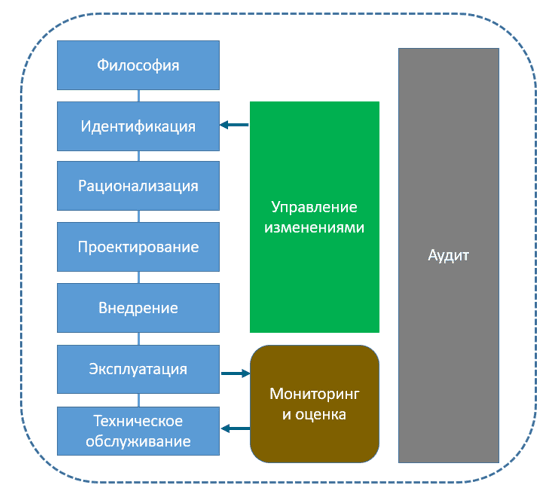
- Philosophy: The first phase of the alarm management lifecycle focuses on developing an alarm management philosophy. This document establishes criteria for deviations that will trigger alarm management measures, including design, operation, and maintenance cycles. The philosophy should contain rules for classification and alarm priority systems, as well as color usage for displaying alarm signals on the dispatcher's control panel (HMI). The document should establish key control indicators, such as acceptable operator load (average number of alarms per hour).
- Identification: Study of work processes and determination of necessary alarm signals.
- Rationalization: Checking alarm signals for compliance with requirements outlined in the alarm management philosophy, including prioritization, classification, settings, and documentation.
- Design: The process of detailed alarm design so that it meets requirements defined in philosophy and rationalization. All this includes decisions on HMI display and special and advanced methods for alarm management system control.
- Implementation: Includes direct implementation of the alarm system in the process control system, commissioning, testing, and personnel training.
- Operation: Use of the alarm system on a working project. Personnel retraining is conducted if necessary.
- Maintenance: During maintenance, the alarm system is not operational. Checks are conducted during stable process, in manual control mode, or during planned process shutdown.
- Monitoring and Assessment: continuous monitoring of alarm system operation and verification of compliance with philosophy goals.
- Management of Change: Making changes to the alarm system according to approved change procedures.
- Audit: The audit stage includes more comprehensive analysis not only of the alarm system operation itself, but also various related work processes. In addition to audits, issues requiring attention are studied, interviews are conducted, recommendations are prepared, and work plans for improving alarm management systems are developed.
- Monitoring and Assessment: are important stages in alarm management system operation. To evaluate system performance, a working group of qualified specialists is created who evaluate its effectiveness on a daily basis based on key performance indicators, as well as identified system deficiencies that are eliminated through change management procedures.
Notification System
Definition of Alarm and Advisory Signals
All the variety of alarm signals arriving at the technological process dispatcher's panel is conditionally divided into two types of signals: advisory and alarm signals.
Alarm signals are used to notify about upcoming process changes or exceeding equipment operating threshold values.
Advisory signals are used to inform the dispatcher about acceptable threshold values for process optimization or for diagnostic messages. Alarm and advisory signals together are called notifications. The purpose of each signal is presented in the table in Fig.2. All notifications are defined by their acceptability limits. The following acceptability limits are distinguished:
- Limit - a specific restrictive measure imposed on equipment, for example, design pressure or temperature of a vessel, which imposes restrictions on equipment operation.
- Threshold values - the value of a variable (pressure, temperature) determined by an instrument, equipment, production, or other operating conditions. When threshold values are exceeded, a notification is generated.
- Setpoints - device setpoints (for example, a threshold relay) that generate notifications are calculated based on threshold values.
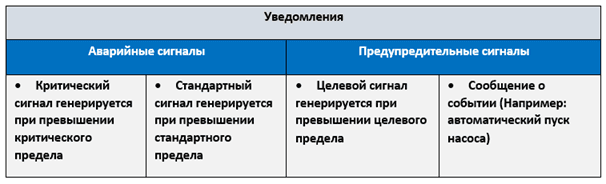
An important characteristic of the notifications shown in the table in Fig.2 is their priority, which is determined by two factors:
- Severity of consequences that the shift engineer must prevent upon receiving an alarm signal (in terms of safety, environmental protection, and economic losses).
- Access time, i.e., the dispatcher must have the time necessary to make a decision and issue a command and obtain the desired result.
Signal Classification
To create a flexible alarm system and convenience of working with large arrays of notifications, in addition to four main priorities, priority subdivisions should be used, formed by their common characteristics, for example, fire alarm can be classified as critical alarm, but is displayed differently than all critical alarms, and has different sound accompaniment. For example, below are listed signal classes and their brief description.
Alarm signals:
- fire;
- gas detection;
- high critical or standard (level, temperature, pressure, current, vibration, axial displacement, etc.);
- low critical or standard (level, temperature, pressure, current, etc.);
- manual emergency stop from button.
Advisory signals:
- high target (level, temperature, pressure, current, etc.);
- low target (level, temperature, pressure, current, etc.).
Equipment status and operating mode signals:
- on/off;
- valve open/closed/intermediate position;
- button press (start, stop, open, close, etc.);
- local/remote control;
- manual/automatic control.
Diagnostic signals:
- sensor malfunction;
- input/output module malfunction;
- processor module malfunction (error, program error, battery malfunction, etc.);
- sensor break;
- communication channel break.
Interlock signals:
- high interlock (level, temperature, pressure, current, vibration, gas detection, fire, axial displacement, leaks, etc.);
- low interlock (level, pressure, current, etc.).
Factors Determining Signal Priorities
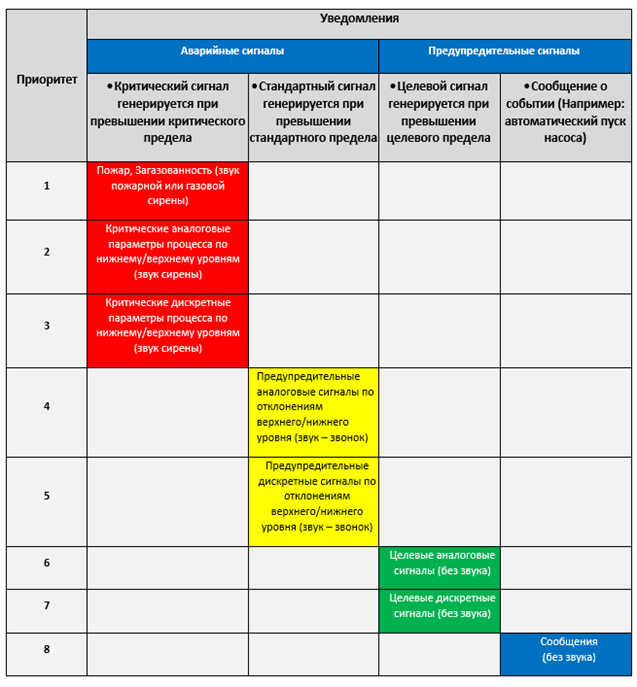
To create a flexible alarm system, in addition to four main priorities, priority subdivisions should be used – for example, fire alarm, which can be classified as critical alarm, but is displayed differently than all critical alarms, and has different sound accompaniment. Considering the fact of "signal" load on the dispatcher, most alarms should be classified as low priority. The higher the priority, the fewer alarms should belong to it. Alarm priorities should be assigned according to danger level and acceptable response time. Signals with lower danger levels and longer response times should have lower priority. For diagnostic alarms (sensor, controller, communication channel malfunctions, etc.), signals with reduced priority are usually used.
The main goal of establishing alarm priorities is ergonomic, i.e., signal prioritization should help the dispatcher highlight the most important signals from the total number of alarms and promptly make decisions and take actions on them. Alarm priorities are set depending on the degree of alarm importance. There are eight priorities in the alarm system in total. The most important signals start with the first.
Alarm Setpoints
When developing alarm systems, it is necessary to conduct thorough analysis of alarm setpoints for each parameter and justify their values. It should be considered that the setpoint at which alarm activation occurs should differ from the normal process value to ensure the necessary level of protection and sufficient response time for the shift dispatcher.
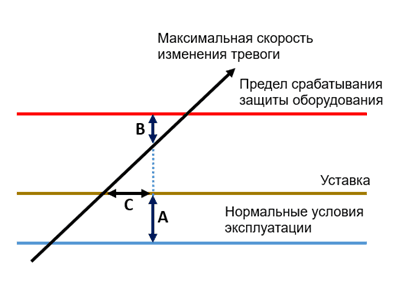
A – normal process operation range
B – range in which the operator controls process deviation and its emergency shutdown C – alarm response time and decision-making by dispatcher
Equipment protection limit – emergency shutdown system activation
Alarm System Development
According to Alarm Management standards, the following stages of alarm system development can be identified:
-
Alarm system design for new designed facilities (initial alarm system setup).
-
Alarm optimization or alarm system redesign for existing facilities.
-
Alarm analysis and configuration during operation.
Initial Alarm System Setup
The initial notification setup process consists of two phases: identification and rationalization. A working group is created to build the alarm system. Working group members must:
- know the equipment and technological processes used;
- know the structure and operation of the automated control system;
- possess programming skills;
- know the alarm system structure, etc.
Identification
During the identification phase, data collection is carried out for all restrictions, threshold values, existing notifications, and system variables. The obtained data is stored in the main database for each alarm system. This database is called the variable table.
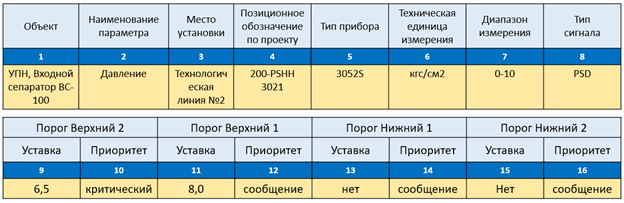
Rationalization
The main task of rationalization is creating the most effective and functional alarm system that provides the shift engineer with only the most important and significant signals.
During rationalization, the following steps are performed:
- bringing the alarm database to a unified style and requirements;
- optimizing the number of alarms arriving at the shift engineer's workstation.
Alarm System Implementation
Before starting alarm system implementation work, a detailed work plan must be compiled, including all implementation steps, including preparation of necessary documentation and personnel training. Before implementing the alarm system, it is tested and verified. All processes are documented. The last step in alarm system implementation should be updating the alarm database.
Alarm Management System Effectiveness Evaluation
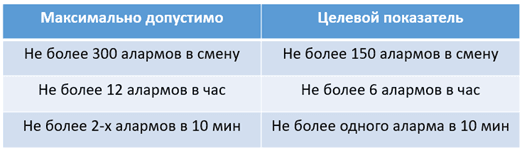
To ensure safe process operation, a reliable and effective alarm management system is required that does not contradict the alarm management philosophy. Standard ISA–18.2 proposes average load on the duty dispatcher shown in Fig. 6. If these parameters are exceeded, the alarm management system may prove ineffective in assisting the dispatcher.
Effective use of alarm priorities can expand the dispatcher's alarm management capabilities and ensure the effectiveness of their actions. The dependency of the number of alarms by priorities during "normal" process flow should comprise approximately the following proportions:
- critical - less than 1%;
- standard - less than 5%;
- target/advisory - less than 15%;
- event message - less than 80%.
This will allow the dispatcher to analyze all signals arriving at their panel and take necessary measures. For more complete control of alarm management system effectiveness, key performance indicators proposed by standards ISA–18.2 and EEMUA 191 are used. These tables are filled automatically by the process control system and analyzed by the alarm management working group on a daily basis. For each deviation, its root cause is considered and measures for their elimination are prepared.
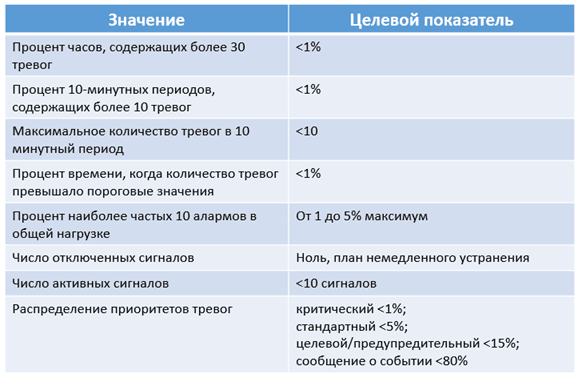
But this is only an example recommended by the above standards. The working group can establish additional values or criteria for evaluating system operation effectiveness itself. For example, add to the table the number of active emergency shutdown interlocks, or the number of disabled signals in the process control system.
Alarm System Maintenance
For the entire operating time of the process control system, alarm system maintenance is necessary to maintain guaranteed working condition. Alarm functionality checks are conducted during process control system maintenance. During alarm maintenance, alarm functions are blocked and under observation of the duty dispatcher and field personnel. After commissioning repaired, modernized, or new devices, the instrumentation service needs to check alarm functionality for the devices.
Management of Change
All necessary changes or modifications to the alarm management system are guided by the Management of Change Procedure adopted at the specific enterprise. All changes to the system and verification methods are properly documented.
Currently, humanity has stepped into technology development where artificial intelligence finds wide application in process control systems, allowing the system to operate almost autonomously, but nevertheless, human control over machine operation remains relevant, since risks of major accidents and man-made disasters increase with technology complexity, despite reliable emergency shutdown systems. And very important in this technological chain is the interface between machine and human, one element of which is the alarm management system.