API RP 571 Course
The course "API RP 571 - Damage Mechanisms of Stationary Equipment in the Oil Refining Industry" is based on API RP 571 practice, which contains useful information about various degradation mechanisms affecting stationary equipment in the oil refining industry.
The course is designed to teach how to identify, analyze and prevent equipment damage, as well as conduct necessary inspections and tests.

Management System
ISO 9001:2015
ID 9000012276
www.tuv.com
API RP 571
API RP 571 is a recommended practice of the American Petroleum Institute (API) that provides information about various types of equipment and materials used in the oil and gas industry, as well as the causes of their potential damage.
API RP 571 practice contains information about mechanical damage, corrosion, cracks, material fatigue and other factors that can affect the safety and efficiency of equipment operation. It also describes methods for diagnosing and assessing damage, as well as technologies and methods for their prevention.
API RP 571 can be used as a tool for assessing equipment condition and for developing maintenance and monitoring programs that will help prevent unexpected failures and accidents.
It is important to note that API RP 571 is not a standard and does not contain design recommendations, but only describes methods for assessing equipment condition and evaluating risks of its damage.
Who the course is for
API RP 571 practice can be useful for equipment integrity specialists: engineers, inspectors, process chemists, designers and other professionals working in the oil and gas industry who wish to obtain API 571 certification demonstrating knowledge of degradation mechanisms encountered in refining and petrochemical industries.
General course information
Understanding degradation mechanisms is necessary when assessing remaining equipment service life. The training course demonstrates in detail all 66 damage mechanisms contained in API 571 recommended practice.
Objects covered in API 571 practice
The following assets and equipment may be affected by damage mechanisms described in API 571:
- All process piping designed in accordance with ASME B31.3 and inspected in accordance with API 570.
- All pressure vessels designed in accordance with ASME Sec VIII and inspected in accordance with API 510.
- All inspectable tanks designed in accordance with API 650 and inspected in accordance with API 653.
API 571 training course objectives
- Help master basic concepts and terms related to equipment damage mechanisms in the refining industry.
- Review various types of degradation mechanisms, their causes, factors and manifestations.
- Teach identification of potential degradation mechanisms for different types of equipment and operating conditions.
- Teach anticipation of which equipment may be affected by specific degradation mechanisms under certain design and operating conditions.
- Teach development of strategies for preventing and managing degradation mechanisms, including selection of materials, design solutions and operating modes.
- Teach methods of equipment inspection and testing to identify and assess degradation mechanisms.
- Teach prevention of known degradation mechanisms.
- Familiarize with regulatory documents and API standards governing equipment integrity issues in the refining industry.
- Prepare for successful API 571 examination to obtain API 571 certificate – "Damage Mechanisms of Stationary Equipment in Refining Industry".
- Increase qualifications and competitiveness in the refining industry labor market.
- Expand professional knowledge and skills in corrosion and materials science.
What you will get by taking the course
Organizations that send their employees to this course will receive trained API 571 specialists capable of controlling potential degradation mechanisms that may affect the company's production assets. Ultimately, this will help rationally use assets, eliminate failures and accidents, and ensure safe equipment operation.
Upon completion of testing, a certificate of successful course completion is issued.
API 571 Course Program
Day 1
Introduction to failure mechanisms
Industrial facility incidents
Approaches to determining failure mechanisms
Control of failure mechanisms
Integrity operating windows
Equipment condition assessment methods
Refinery equipment
Failure mechanisms at industrial facilities (all industries)
Failure mechanisms caused by changes in mechanical and metallurgical properties:
- Graphitization.
- Temper embrittlement (Spheroidization).
- Temper embrittlement.
- Strain aging.
- 475°C embrittlement.
- Sigma phase embrittlement.
- Brittle fracture.
- Creep and stress rupture.
- Thermal fatigue.
- Short-term overheating - stress rupture.
- Steam stagnation.
- Dissimilar metal weld cracking.
- Thermal shock cracking.
- Erosion / Erosion-Corrosion.
- Cavitation.
- Mechanical fatigue.
- Vibration fatigue.
- Lining failure.
- Reheat cracking.
- Ignition and combustion enhanced by gaseous oxygen.
Day 2
Industrial facility incidents
Incident investigation and failure mechanism identification
Failure mechanisms at industrial facilities (all industries)
Failure mechanisms leading to local or general thinning
- Galvanic corrosion.
- Atmospheric corrosion.
- Corrosion under insulation.
- Cooling water corrosion.
- Boiler water condensate corrosion.
- CO2 corrosion.
- Fuel gas condensation temperature corrosion.
- Microbiologically influenced corrosion (MIC).
- Soil corrosion.
- Alkaline corrosion.
- Dealloying.
- Graphitic corrosion.
Practical exercise on failure mechanism identification, IOW and control
Day 3
Industrial facility incidents
Failure mechanisms at industrial facilities (all industries)
High-temperature corrosion
- Oxidation.
- Sulfidation.
- Carburization.
- Decarburization.
- Metal dusting.
- Fuel ash corrosion.
- Nitriding.
Practical exercise on failure mechanism identification, IOW and control
Day 4
Industrial facility incidents
Failure mechanisms at industrial facilities (all industries)
Stress corrosion cracking
- Chloride stress corrosion cracking.
- Corrosion fatigue.
- Caustic stress corrosion cracking (Caustic cracking).
- Ammonia stress corrosion cracking.
- Liquid metal embrittlement (LME).
- Hydrogen embrittlement (HE).
- Fuel ethanol stress corrosion cracking.
- Sulfate stress corrosion cracking.
Practical exercise on failure mechanism identification, IOW and control
Day 5
Industrial facility incidents
Failure mechanisms at industrial facilities (refineries)
Failure mechanisms leading to local or general thinning
- Amine corrosion.
- Ammonium bisulfide corrosion (Alkaline sour water).
- Ammonium chloride corrosion.
- Hydrochloric acid (HCl) corrosion.
- High-temperature H2/H2S corrosion.
- Hydrofluoric acid (HF) corrosion.
- Naphthenic acid corrosion (NAC).
- Phenolic corrosion (carbolic acid).
- Phosphoric acid corrosion.
- Sour water corrosion (acidic).
- Sulfuric acid corrosion.
- Organic acid water corrosion.
Stress corrosion cracking
- Polythionic acid stress corrosion cracking.
- Amine stress corrosion cracking.
- Wet H2S damage (Embrittlement / SOHIC / HISC / SSC).
- Hydrogen stress cracking – Hydrofluoric acid.
- Carbonate stress corrosion cracking.
Other mechanisms
- High-temperature hydrogen attack (HTHA).
- Titanium hydriding.
Practical exercise on failure mechanism identification, IOW and control
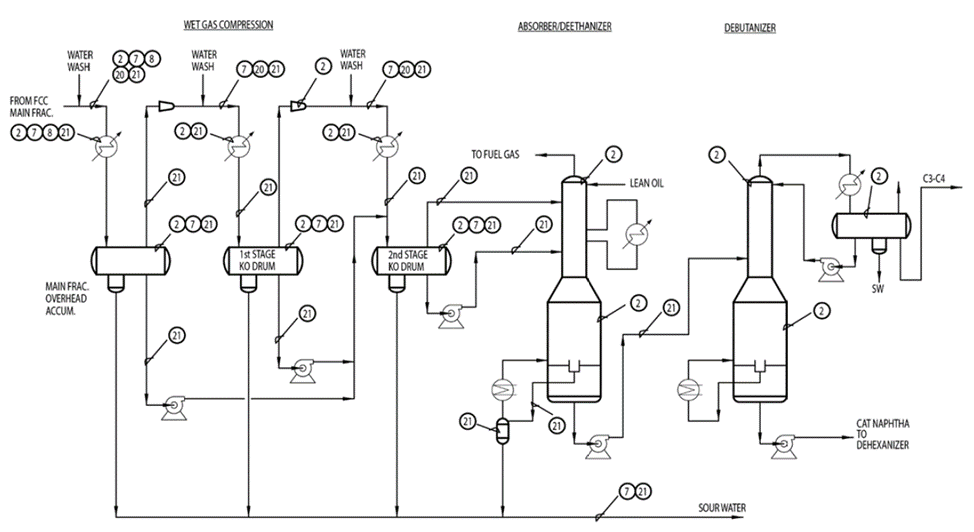
Fig.1 Typical unit for investigation