EPD certificate
Information about a product's environmental impact at each stage of its life cycle has become a critically important factor. EPDs allow manufacturers to disclose information in a reliable, optimized and universally understandable way.
EPD certification allows for the transmission of environmental information in a standardized way and represents a useful tool for manufacturers, importers, suppliers, buyers, sellers and end users.
Management System
ISO 9001:2015
ID 9000012276
www.tuv.com
Environmental Product Declaration (EPD)
EPD is a comprehensive, internationally agreed Type III environmental declaration report created by the product manufacturer, which documents quantitative indicators of the product's environmental impact throughout its entire life cycle (Fig. 1). The programme operator - an organization or body approved to issue EPDs - certifies that all information in the manufacturer's prepared EPD is accurate.*
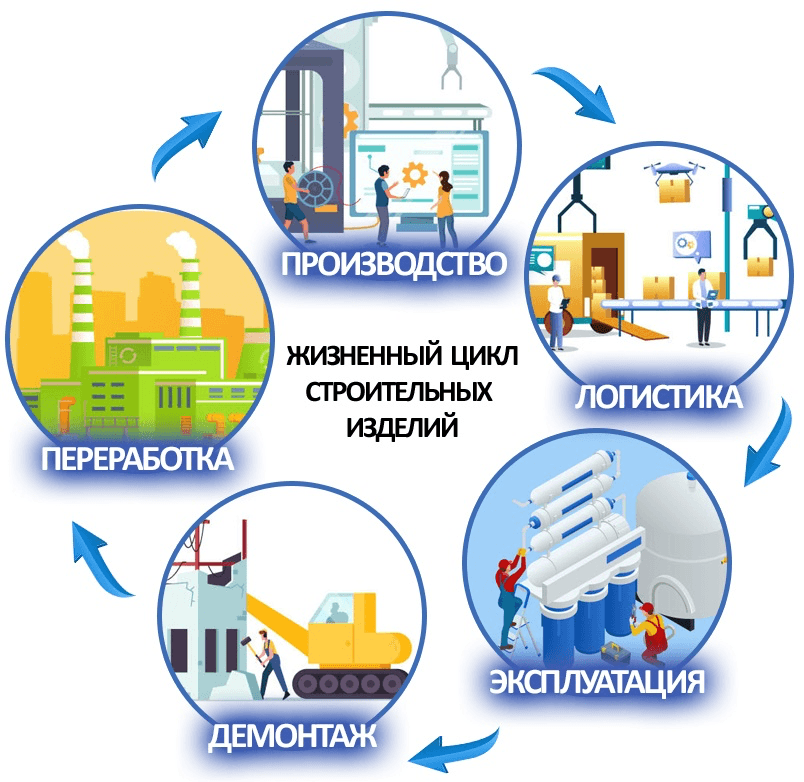
Fig 1. Life cycle of construction products.
EPD Development Process
EPD development in compliance with International Organization for Standardization (ISO) 14025 is conducted in five stages (Fig. 2):
- Finding suitable Product Category Rules (PCR). The first step in creating an EPD is searching for or creating PCR applicable to one or more product categories (groups of homogeneous products). PCR provide requirements for calculations and reporting to create Life Cycle Assessments (LCA) and EPDs.
- Conducting and verifying product LCA (Life Cycle Assessment). LCA is a comprehensive report documenting the product's impact at all stages of its life. After LCA is conducted for a specific product, it must be verified by an independent party to ensure it meets the requirements defined in PCR, ISO 14040 and ISO 14044.
- Compiling the EPD. The EPD must reflect LCA results along with additional information about product properties and other sustainability attributes.
- EPD verification. An independent third party conducts thorough analysis and verification of the results presented in the EPD.
- EPD registration. The operator registers and publishes the EPD in their databases. EPDs are typically valid for five years.
For the construction sector, the European Committee for Standardization (CEN) has adopted standard EN 15804, containing basic product category rules (PCR). As an additional standard for environmental assessment of buildings, CEN published standard EN 15978. To assess the life cycle of buildings and infrastructure projects by providing reliable product data in an accessible and efficient manner, major international EPD verification program operators in the construction sector have created the ECO platform. ECO's goal is an open international network of digital data for LCA in construction. Some of these program operators have concluded bilateral mutual recognition agreements.
The foundational EPD standard, EN 15804, has gained widespread adoption worldwide. In July 2019, a major amendment EN 15804 + A2 was approved, which significantly changes EPDs and will become mandatory in July 2022.
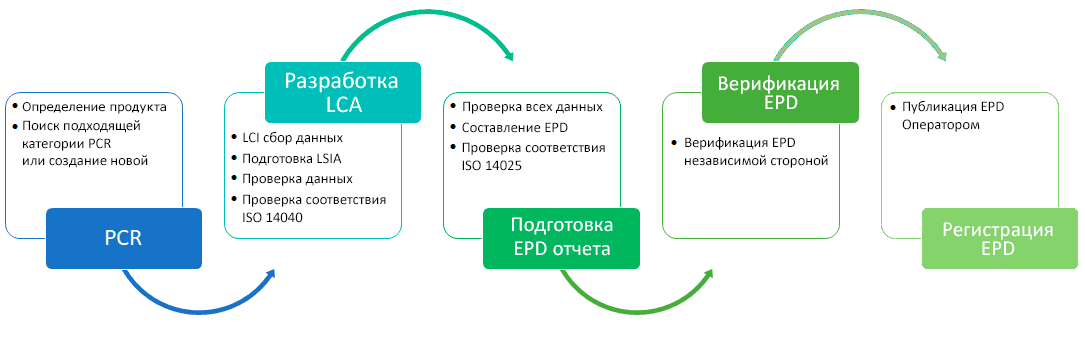
Fig. 2. EPD preparation stages.
EPD Declaration Development Services
If you need assistance obtaining an EPD compliant with ISO 14025 and EN 15804 standards, RBI Concept can help you. Our specialists are familiar with relevant standards for many product categories in the market. We are experts in completing necessary LCAs and providing verified and certified EPDs in accordance with EN 15804 or other standards. We work with LCA modeling software and are ready to help your organization.
*ISO has proposed three categories of environmental labels according to the aspects covered and the degree of rigor required for awarding the label: Type I in ISO 14024; Type II in ISO 14021; and Type III in ISO 14025. Another category called "Type I-like" is also encountered, representing environmental labels focused on only one environmental or social aspect; these labels have been issued by independent organizations.