Operational integrity windows of an industrial enterprise
Relevance
The diversity of chemical compositions in production environments, changes in temperatures and pressures during the production cycle require the use of materials with the necessary corrosion resistance and mechanical strength throughout the design service life of equipment. To achieve high economic efficiency of an enterprise, a comprehensive approach to material selection is necessary.
As a rule, materials with excellent mechanochemical properties contain alloying elements Cr, Ni, Ti, Mo, and others in their composition, which affect their cost. In most cases, it is possible to use more accessible materials while observing certain operating conditions.
The set of parameters affecting the equipment material failure mechanism and their permissible ranges, within which equipment operation is possible throughout the design service life, are called Operating Windows of Integrity (OWI).
Solution
For successful implementation of the OWI program at an enterprise, data on the technological process, environments and chemical composition, equipment material, and history of equipment failures and destruction are required. After collecting all necessary data, equipment failure mechanisms and significant factors that can significantly accelerate the degradation process are determined. If such factors can be controlled during facility operation, they are included in the OWI list. Permissible OWI ranges are selected based on operating experience of the given facility, recommendations in corporate, industry, national or international standards and recommended practices. For example, such ranges may include 5 μg/l of oxygen in boiler feedwater, 50 mg/l chloride ion content in environments contacting austenitic stainless steels, etc.
OWI implementation allows identifying parameters that have high influence on material destruction rate, establishing a monitoring system for such parameters through instrument installation or sampling programs, building algorithms for alarms and deviation notifications. Additionally, measures necessary for implementation during deviations are prescribed in advance. They may include notification of specific officials and company management, temperature or feedstock flow rate changes, chemical reagent introduction, etc.
Monthly OWI reports are usually compiled for a plant or individual system, indicating the duration of deviation for each parameter and their magnitudes, list of measures taken, and plan for preventing deviation occurrence.
In cases where OWI development reveals that a parameter cannot be controlled, measures such as scheduling additional inspections to monitor equipment condition, installing stationary online monitoring methods (stationary ultrasonic sensors transmitting data to operator console), installing chemical reagent dosing units (corrosion inhibitors, oxygen/hydrogen sulfide scavengers, pH modifiers, etc.) are taken.
For parameters, limits are assigned depending on the magnitude of consequences, called:
- safe limits;
- standard limits;
- critical limits.
During design, it is assumed that equipment degradation will occur at a certain rate, which is shown as the expected degree of destruction in Figure 1.
With such degree of destruction, there will be gradual reduction in residual life and increased risk throughout equipment operation. That is, maintaining the parameter within safe limits (green zone, Fig. 1) should guarantee accident-free operation throughout the design service life of equipment. When safe limits are exceeded, increased degree of destruction, reduced residual life, and increased risk are observed. All this leads to premature equipment failure (orange zone, Fig. 1). With even greater parameter deviation from safe values, the degree of destruction sharply increases, which can lead to equipment depressurization in a short period of time (red zone, Fig. 1).
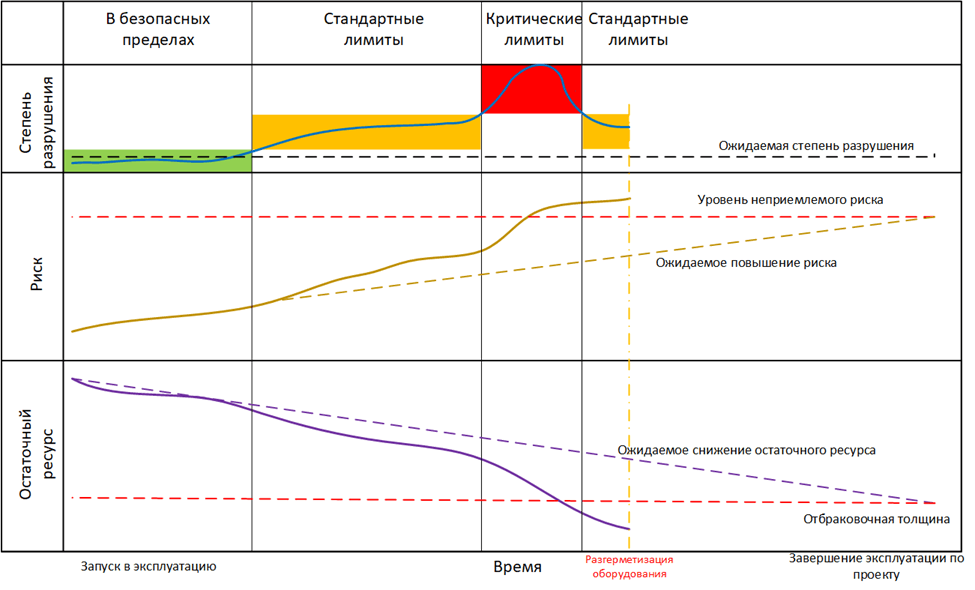
Figure 1. Dependence of degree of destruction, risk, and equipment residual life on the degree of parameter deviation from the safe zone.
Figure 1 shows an example case where a parameter was in the safe zone for a certain time after commissioning, then exceeded the standard limit, and subsequently the critical limit. Necessary measures to return the parameter were taken later than the regulated period. It was possible to reduce the parameter below critical limits, however, the degree of destruction was so great that it affected the residual life. As a result, equipment depressurization occurred.
Conclusions
Thus, deploying the OWI program at an enterprise allows:
- identifying parameters that affect equipment reliability;
- obtaining current information on deviations;
- applying a pre-developed action plan in case of deviations;
- planning shutdowns, inspections, repairs, replacements in case of critical deviations;
- justifying budgeting of additional measures to maintain equipment integrity.
Development of the OWI program is a mandatory component of a production enterprise reliability program.