RCM - Reliability-centered maintenance
Reliability-centered maintenance (RCM) is a methodology for predicting failures, optimizing maintenance and repair of equipment with the goal of ensuring its reliable operation and achieving the required efficiency of the asset management system.
We offer RCM implementation services. We use specialized software for RCM and transfer experience of effective application in foreign and Russian companies.
Management System
ISO 9001:2015
ID 9000012276
www.tuv.com
RCM Implementation Services
Our specialists possess the necessary competencies and tools for implementing RCM methodology in customer assets.
The RCM implementation process consists of the following steps:
- Demonstration of the advantages of using proactive RCM maintenance methodology to the company's technical management.
- Preparation of enterprise standards (regulations, instructions) for RCM.
- Training of Customer company employees.
- Participation in preparing the RCM implementation plan for Customer company assets.
Implementation of the above-mentioned activities will reduce operational maintenance costs, increase equipment availability, and reduce costs for unplanned equipment downtime.
Support
If the customer desires, after RCM methodology implementation, RBI Concept engineers will continue to provide technical and expert support within the framework of the existing contract.
An important element of asset integrity management is specialized software for automating the RCM process, which performs:
- automated data collection;
- equipment condition monitoring;
- determination of condition-based maintenance priority;
- generation of equipment availability reports.
Additional Activities
We provide additional services within the framework of ensuring equipment integrity and availability:
- Implementation of RBI methodology for static equipment.
- Development, implementation and support of RBI software.
- Regular training of Customer engineers in RCM and RBI methods.
Advantages of RCM Application
Application of RCM methodology has a number of significant advantages compared to "traditional" maintenance:
- Increase in the share of condition-based maintenance that allows controlling and preventing, according to failure development models, their greatest number.
- Reduction in the number of failures from applying correct maintenance - corresponding to existing development mechanisms, which allows controlling and preventing failure in a timely manner.
- Improvement of operational reliability and equipment readiness.
- Reduction of labor costs due to decreased share of unplanned maintenance (failure elimination).
- Reduction of material costs due to decreased share of unplanned maintenance and increased share of condition-based maintenance (reduced material requirements).
Where RCM is Necessary
Reliability-centered maintenance (RCM) is primarily necessary for companies with complex technological production, where there are requirements for continuous technological cycles with expensive equipment, where there are high financial consequences due to equipment failure, expressed in production downtime or costs for troubleshooting through repair or purchase of new equipment.
Also, RCM, under certain conditions, allows moving away from the practice of equipment manufacturers imposing scheduled maintenance according to their recommendations, without compromising the functional reliability of equipment.
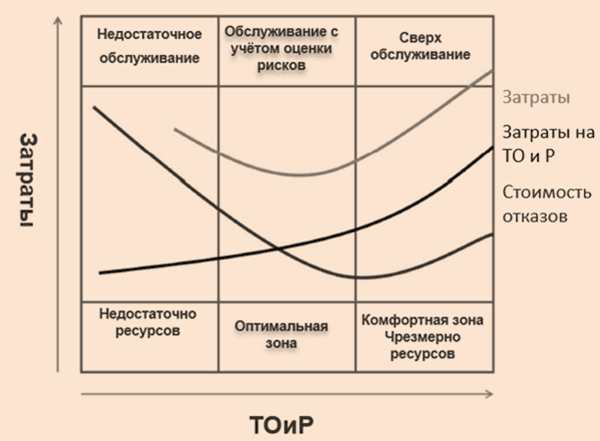
Application of RCM methodology allows solving these problems while maintaining a balance between resources spent on maintenance and the degree of reliability and operational readiness of equipment to perform its functions. This is achieved by applying correct maintenance strategies based on failure analysis and identification of their true mechanisms, which allows successfully controlling, preventing them, or according to risk assessment, operating them to failure in a controlled manner, thereby achieving optimal balance.
RCM Methodology
Reliability centered maintenance (RCM) is based on the postulate that maintaining a unit of equipment in perfect condition is not an end in itself; the goal is to ensure reliable functioning of systems and equipment critical to the production process.
This methodology involves identification and application of correct, and therefore effective, maintenance. This is achieved by studying potential failure mechanisms, assessing their criticality for production activities, and corresponding response in the form of applying a balanced maintenance program that allows optimal use of both material and labor resources, responding to existing threats proportionally.
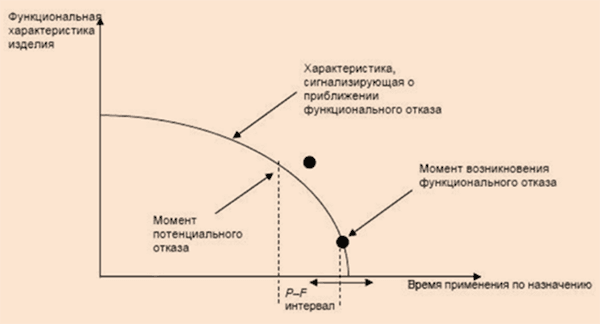
Maintenance and repair using RCM principles consists of transitioning from reactive to proactive maintenance, i.e., monitoring potential equipment failure and its timely prevention, rather than planned unconditional maintenance based on fixed time intervals for replacing material parts and conducting other technical manipulations. As well as allowing controlled run-to-failure operation of equipment where economically justified, without harm to production or safety, typically on auxiliary systems.
RCM Tasks
- Establish main failure mechanisms by equipment units, equipment type, or equipment unit.
- Establish failure models by equipment units (depends on operating time or may occur at any moment under certain conditions).
- Establish failure consequence category (evident – when failure effect is immediate and obvious, or hidden – when failure of one unit has already occurred, but consequences are delayed relative to overall equipment functionality).
- Establish maintenance strategies for equipment units depending on failure category and failure consequences on production activities. Depending on the established maintenance strategy, select specific maintenance tasks/manipulations.
- Determine economically justified, previously established maintenance tasks/manipulations. A technical maintenance action is effective if it prevents or mitigates failure consequences. Economically, a technical maintenance action is effective if the cost of this manipulation is lower than losses/consequences from potential failure. This RCM step is optional.
RCM Stages
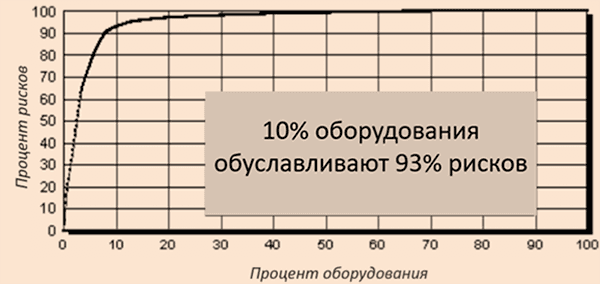
- Identification of critical systems and components, i.e., determining the most important systems and components that have the greatest impact on equipment reliability and availability. See Fig. 3, where failures of 10% of critical equipment account for 93% of risks.
- For each selected system and component, their main functions are determined, as well as requirements for their operability and reliability.
- Analysis of potential failures and their consequences in terms of safety, economic losses, environmental impact, and other factors.
- Based on failure analysis, the most effective maintenance and repair strategies are determined for each component and system.
- Development of a plan specifying frequency and types of maintenance and repair, including functional tests, for each component and system.
- Regular monitoring and analysis of maintenance and repair results to identify problem areas and make adjustments to the maintenance strategy.