Risk Based Inspection
Risk Base Inspection is a modern methodology for optimizing inspections that allows prioritizing inspections and, as a result, strategically concentrating resources in the right way while ensuring safe and stable operation.
Our engineers will prepare qualified assessments and procedures for conducting targeted inspections where and when they are needed. We possess advanced practices, use high-quality inspection equipment, and apply Russian software RBICONCEPT®.
Management System
ISO 9001:2015
ID 9000012276
www.tuv.com
Risk Based Inspection (RBI) Analysis
Implementation of Risk Based Inspection (RBI) brings substantial benefits and allows companies to:
- monitor the actual current technical condition of equipment;
- reduce the number of equipment repairs and spare parts for them;
- timely plan procurement of the necessary quantity of spare parts;
- control the quality of performed repair work;
- increase equipment reliability, extend the period between repairs and service life;
- improve the safety level at their enterprise.
Equipment of industrial enterprises operating under pressure falls under the rules and requirements of supervisory authorities. This includes requirements for inspecting the technical condition of equipment to identify defects and assess remaining service life. The interval between inspections and their scope are regulated by normative documents depending on the type of equipment and composition of the medium.
One option for optimizing inspection is the application of risk-based assessment methodology.
High efficiency of this approach is achieved through redistribution of resources for equipment inspection. Such redistribution becomes possible after assessing consequences and probability of equipment failure. Based on the risk level, which equals the product of consequences and probability, it becomes clear which equipment should have increased inspection intensity or reduced intensity. This approach to planning and conducting inspections is called Risk Based Inspection (RBI).
During RBI approach implementation, consequences of undesirable events on personnel health and safety, environment, and enterprise material losses are considered. Based on obtained risk assessment, the inter-inspection interval and scope of equipment inspection are determined.
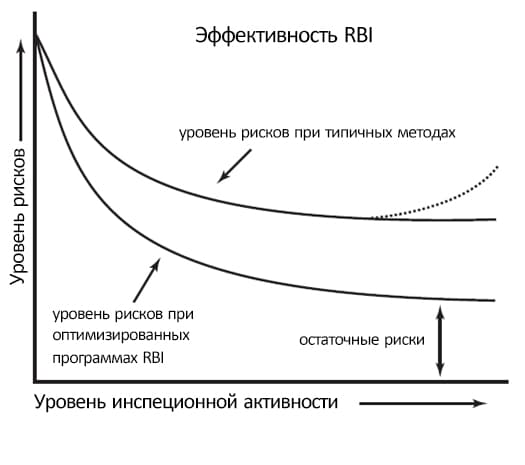
Statistics from countries where RBI methodology is already widely used show that its proper use allows predicting and avoiding up to 80% of equipment failures, equipment damage mechanisms and forming equipment inspection and condition monitoring strategy (see Figure 1):
API 580, API 581, API 571
For organizing the RBI process in Western countries, the following fundamental regulatory documents are applied:
- API-580 Risk-based Inspection;
- API-581 Risk-Based Inspection Technology;
- CWA 15740:2008 Risk-Based Inspection and Maintenance Procedures for European Industry (RIMAP);
- EN 16991 Risk-based inspection framework.
When conducting Risk Based Analysis (RBI), the following standard is used:
- API 571 Damage Mechanisms Affecting Fixed Equipment in the Refining Industry.
API-571 describes equipment damage mechanisms in the refining and petrochemical industry - it is an important first step in equipment safety and reliability management through identification and understanding of various damage mechanisms.
Below is a comparative overview of key standards, including API, GOST R, CWA and EN, indicating their role in RBI methodology:
Overview of standards (API, GOST R, EN, CWA) for Risk Based Inspection (RBI)
| Standard \ Type | Title | Industry of use | Connection to RBI | Brief description |
|---|---|---|---|---|
| API 510 \ Code | Pressure Vessel Inspection Code: In-Service Inspection, Rating, Repair, and Alteration | Oil and gas, petrochemical, chemical, energy | Uses RBI for pressure vessel inspection planning | Inspection, repair, modification and reassessment of pressure vessels in service. RBI is used to optimize control plans. |
| API 570 \ Code | Piping Inspection Code: In-service Inspection, Rating, Repair, and Alteration of Piping Systems | Oil and gas, petrochemical, chemical, pipelines | Uses RBI for piping inspection planning | Inspection, repair, modification and reassessment of piping systems in service. RBI is applied to optimize control. |
| API 571 \ RP | Damage Mechanisms Affecting Fixed Equipment in the Refining Industry | Oil and gas, petrochemical | Damage mechanism data for Probability of Failure (PoF) assessment in RBI | Description of equipment damage mechanisms. Basis for Probability of Failure (PoF) assessment in RBI methodology. |
| API 573 \ RP | Inspection of Fired Boilers and Heaters | Oil and gas, petrochemical, energy | May use RBI for inspection planning | Inspection of industrial furnaces and boilers. RBI can be used for planning inspections of this equipment. |
| API 576 \ RP | Inspection of Pressure-relieving Devices | Oil and gas, petrochemical, chemical, energy | May use RBI for determining PRD inspection intervals | Inspection of pressure relief devices (PRD). RBI can help determine check frequency for risk management. |
| API 579-1/ASME FFS-1 \ Std / RP | Fitness-For-Service | Oil and gas, petrochemical, chemical, energy | Fitness-For-Service (FFS) assessment of defects identified by inspections (including RBI) | Fitness-for-service assessment of equipment with defects. Analysis of inspection findings, often planned using RBI. |
| API 580 \ RP | Risk-Based Inspection | Oil and gas, petrochemical, chemical, energy | Defines fundamentals and minimum requirements for RBI methodology | Fundamentals of Risk Based Inspection (RBI) methodology. Defines minimum requirements for RBI program. |
| API 581 \ RP | Risk-Based Inspection Methodology | Oil and gas, petrochemical, chemical, energy | Provides quantitative methodology for RBI implementation | Risk Based Inspection (RBI) methodology. Provides quantitative risk calculation methods for API 580 implementation. |
| API 584 \ RP | Integrity Operating Windows | Oil and gas, petrochemical, chemical | Data (IOWs) for risk management within integrity program (including RBI) | Integrity Operating Windows (IOW). Definition of critical parameters for equipment risk control. |
| API 653 \ Standard | Tank Inspection, Repair, Alteration, and Reconstruction | Oil and gas, petrochemical, storage terminals | Uses RBI for tank inspection planning | Inspection, repair, alteration and reconstruction of steel storage tanks. RBI helps optimize inspection strategy. |
| GOST R 55234.3-2013 \ (Russia) GOST R | Risk-based inspection. Part 3. Application of risk-based inspection | Oil and gas (especially offshore facilities) | Russian standard for RBI methodology application | Establishes procedures and methodological foundations for risk-based inspection application for oil and gas industry facilities in Russian Federation. |
| CWA 15740:2008 \ CWA | Risk-Based Inspection and Maintenance Procedures for European Industry (RIMAP) | Energy, mechanical engineering, metallurgy, chemical | RIMAP methodology using RBI for maintenance and inspection planning | Pre-standard document describing unified approach to risk-based inspection and maintenance. Basis for EN 16991. |
| EN 16991 \ EN | Risk-based inspection framework | Universal (energy, chemical, oil and gas, processing) | European standard for RBI program implementation | European standard for RBI implementation. Generalizes and develops RIMAP approach, formalizing RBI program structure and requirements. |
Term definitions
- API (American Petroleum Institute): American Petroleum Institute.
- GOST R: State Standard of the Russian Federation.
- ASME (American Society of Mechanical Engineers): American Society of Mechanical Engineers.
- CWA (CEN Workshop Agreement): Document prepared within CEN working group framework, not mandatory but used as preliminary standard.
- EN (European Norm): European standard adopted by CEN.
- Code: Document containing mandatory requirements (rules).
- RP (Recommended Practice): Document containing recommendations and best practices.
- Standard: Document establishing norms, rules, characteristics or methods.
- RBI (Risk-Based Inspection): Methodology for planning inspections based on assessment of equipment failure probability and consequences.
- PoF (Probability of Failure): One of two key risk components in RBI.
- PRD (Pressure Relief Devices): Equipment for protecting systems from pressure exceedance.
- FFS (Fitness-For-Service): Assessment of safe operation possibility for equipment with defects.
- IOW (Integrity Operating Windows): Established limits for parameters affecting equipment integrity.
- Damage mechanisms: Mechanisms causing material degradation (corrosion, erosion, fatigue, etc.).
RBI Process Organization
RBI methodology allows building an effective maintenance and repair strategy for static equipment, considering application of effective NDT methods in necessary volumes, at the right time and in the right place to maintain current risk level at acceptable level.
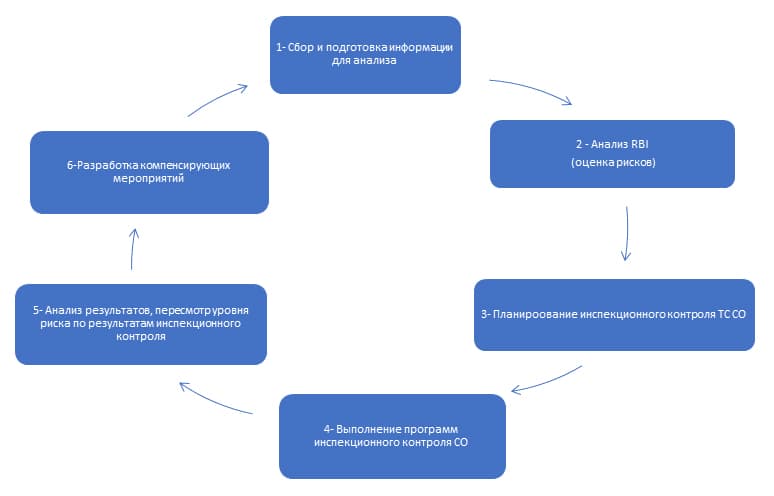
Inspections themselves do not prevent degradation mechanisms manifestation, but help in identifying, characterizing, monitoring and measuring these degradation mechanisms. RBI is an invaluable tool for predicting type and rate of degradation, which means better predictability of any potential failure. Inspections contribute to reducing failure probability and consequently reduce risk. The equipment management scheme and RBI process place in it looks as follows (see Figure 2):
Expert Group Organization
For effective RBI process management, enterprises create expert groups. The group includes specialists from related fields with sufficient competency levels.
Approximate expert group composition:
- Equipment reliability manager – group leader.
- Equipment reliability engineer.
- Corrosion and materials engineer.
- Operations department representative.
- Maintenance department representative.
- Safety department representative.
- Other specialists as needed.
Degradation Mechanisms Definition
Degradation mechanism is a specific type of impact on equipment metal, arising under certain operating conditions, leading to loss of metal load-bearing properties and mechanical integrity violation (depressurization) of equipment. Degradation mechanism (DM) impact potential is determined based on:
- technological medium composition and aggressiveness of corrosive substances in its component composition;
- equipment operating parameters;
- equipment material implementation;
- presence and condition of protective and insulation coatings;
- presence of heat treatment of equipment elements;
- climatic conditions impact.
Corrosion Circuits Definition
Corrosion circuit – a section of technological unit consisting of similar construction materials and operated under similar technological process conditions and consequently subjected to similar predicted DMs, and having close corrosion rates. One of data systematization methods is creating corrosion circuits. Creating corrosion circuits is equipment systematization with allocation of certain schematic circuits within technological scheme, uniting technologically connected equipment.
For each corrosion circuit, critical parameters that influence equipment degradation and should be controlled during technological process are determined.
Failure Probability Assessment
Through RBI methodology, probabilities and possible failure consequences are determined, based on which risk magnitude is assessed, and corresponding dependence of risk analysis indicators on maintenance frequency increase or decrease is built so that sections with high risk probability receive special attention, while low-risk sections are checked proportionally to their risk level.
Within RBI analysis framework, risk assessment is conducted and mechanical integrity loss probability is determined depending on technical parameters and technological process conditions.
Failure Consequences Assessment
Consequences assessment is performed based on collection and analysis of data such as main mode parameters, characteristics of substances used in production, failure history of individual equipment elements and others.
For each possible failure mode, probability and failure consequences must be determined. Failure consequences can be divided into three categories: economic consequences, human health consequences and environmental damage. All consequences are expressed in monetary terms.
Total consequences are the sum of listed consequence categories:
Total consequences = Economic consequences + Human health consequences + Environmental damage
Corporate risk assessment matrix classification of equipment failure economic consequences is possible.
Failure consequences degree or damage size are ranked in 5 classes:
A – minor impact or damage;
B - small impact or damage;
C - moderate impact or damage;
D - significant impact or serious damage;
E – catastrophic impact or large-scale damage.
Risk Determination
Risk level is determined as the product of failure probability level and failure consequences level:
It should be noted that failure probability in this equation is a function of time. This is because DM damage degree, on which failure probability depends, increases as damage accumulates in the component over time. For convenience of risk assessment perception, a graphical tool is used – risk matrix.
Risk Matrix
The key element of RBI methodology is the risk matrix. One axis displays event probability, and the other displays event consequences. Matrix appearance, consequence categories and probabilities can be changed depending on enterprise specifics, its location, corporate, state and international standards and rules.
Example of risk ranking table (see Figure 3):
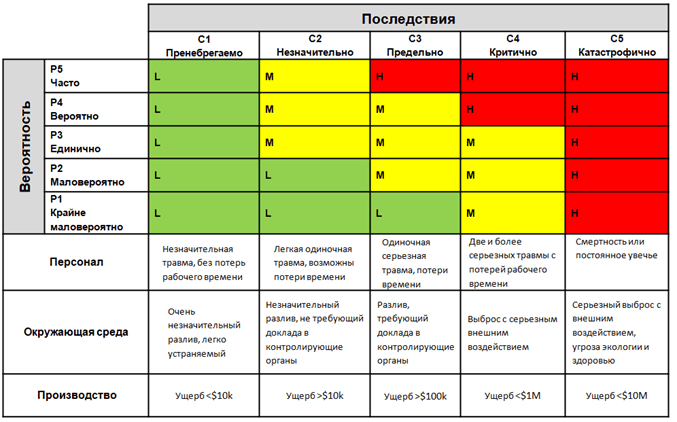
Determining these parameters helps establish risk level for each equipment unit or its elements and set inspection intervals based on calculated risk. This allows excluding low-risk equipment inspections and focusing efforts on equipment in critical risk zone.
The RBI process considering the above can be displayed as a scheme (see Figure 4):
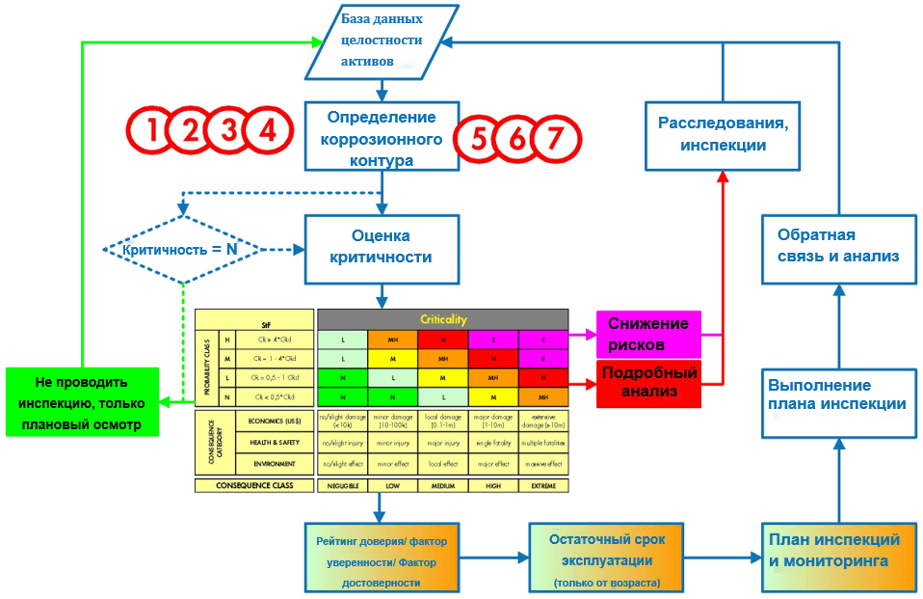
During equipment inspection, risks that appear in the critical zone of risk assessment table require immediate measures to reduce them and move them to yellow or green zone. See Fig.4 Risks in yellow zone require assessment for acceptability of these risks as acceptable. Here the ALARP (As Low As Reasonably Practicable) principle is used, the application of which is described and standardized in document [7]. Guided by this principle, the RBI expert group prepares recommendations. Risks in green zone do not require any corrective measures. Possibly, inspection interval increase is required.
Equipment Technical Condition Control Planning
Based on risk assessment results, a comprehensive Equipment Technical Condition Control Program is developed, including equipment technical condition monitoring during operation by tracking IOW indicators, and inspections.
The basis for planning scope, selecting methods, timing and frequency of Equipment Technical Condition Control is the risk assessment result for each equipment and should be correlated with the Risk Matrix.
For each damage mechanism to which specific equipment circuit is subjected, target Equipment Technical Condition Control date is calculated. Target date is the date when current risk reaches maximum acceptable risk magnitude, this is the main marker for controlling and preventing failure occurrence, therefore established equipment scope and examination methods must be conducted no later than obtained target examination dates.
Risk Mitigation Measures
In case inspections do not reduce risk level for equipment, for example, corrosion defects approach maximum allowable rejection values, or damage intensity does not allow further safe equipment operation, the following measures can be performed to reduce risk to acceptable level:
- Technological process parameters change;
- permanent parameter monitoring;
- Equipment repair;
- Equipment element or entire equipment replacement;
- Equipment/unit modernization;
- Additional corrosion protection measures application;
Integrity Operating Windows (IOW) Definition and Use.
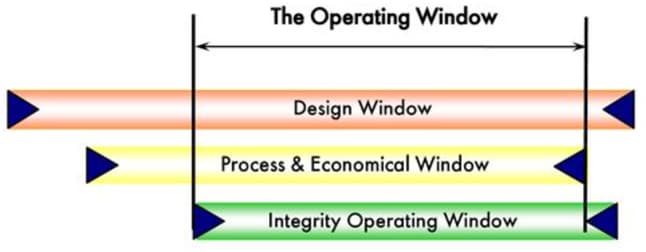
For each analyzed equipment component or corrosion circuit, RBI expert group determines key technological process parameters or other conditions that influence degradation rate.
For each such parameter, optimal, safe range boundaries are established from materials resistance viewpoint. The range of key parameter change within established boundaries is called Integrity Operating Window (IOW) (see Figure 4):
RBI Capabilities
RBI analysis implementation allows:
- preventing failures, incidents and accidents through early detection of unfavorable changes in equipment condition;
- implementing equipment reliability and safety measures proactively;
- identifying destruction mechanisms, using control methods and mitigation measures as a result of involving specialized experts;
- using most effective NDT methods through inspection effectiveness assessment;
- planning equipment maintenance considering its actual condition;
- ensuring integrity through continuous improvement of equipment management process;
- effectively using resources in enterprise equipment management;
- creating enterprise equipment management system with clear KPIs, with possibility of planning operational and capital expenses.