HAZOP
HAZOP (Hazard and Operability Study) is a method of systematic and structured analysis of technological processes aimed at identifying potential hazards (HAZard) and problems related to the operability (OPerability) of the system. This is one of the most widely used risk analysis methodologies in the chemical, oil and gas, pharmaceutical, and other industries.
HAZOP examines possible risks of system or installation deviations during the design stages of an object or equipment when all technological and design decisions have been made. We offer HAZOP analysis services - from studying a single unit to large enterprises at various project stages.
Management System
ISO 9001:2015
ID 9000012276
www.tuv.com
HAZOP Analysis
HAZOP (Hazard and Operability Study) is a method of systematic and structured analysis of technological processes aimed at identifying potential deviations that may lead to accidents, threats to life, or reduced production efficiency. It is one of the key risk management tools in the oil and gas, chemical, pharmaceutical, and energy industries.
The method is used both at the design stage of facilities and during modernization or operation of existing installations. Its purpose is to anticipate possible problems before construction begins or equipment is launched, in order to eliminate or minimize the consequences of deviations while still on paper.
Why is HAZOP important?
Any production is a complex system where even a small deviation from the norm can provoke a serious incident. HAZOP allows comprehensive consideration of each operation, equipment, and process parameter from the perspective of:
- personnel and environmental safety,
- reliability of plant operation,
- stability of the technological cycle.
This is not just a formal analysis — it is an opportunity to understand in advance where and why a failure might occur, and what needs to be done to prevent it.
HAZOP Research Directions
HAZOP analysis covers four key areas:
- Processes — assessment of technological systems and equipment.
- Procedures — verification of operational sequences and work instructions.
- Personnel — identification of human factors affecting safety and operability.
- Software — analysis of algorithms and software controlling automated systems.
At the initial stage, a list of possible hazards is compiled and their significance for further assessment is determined. Key parameters of the technological process are used as a basis — for example, pressure, temperature, flow rate. Then the list is supplemented with other factors characteristic of the specific system.
The analysis is conducted in discussion mode, with the participation of a team of specialists well familiar with the process. The project is divided into separate nodes, each of which is thoroughly investigated for possible deviations from design solutions.
History and Development of HAZOP
Over time, the method gained international recognition and was standardized. Today, HAZOP is widely used worldwide and is a key risk analysis tool in high-tech and high-risk industries such as oil and gas, chemical, pharmaceutical, and energy industries.
Standards Regulating HAZOP Conduct
HAZOP is recognized by several international standards, including:
- IEC 61882:2016 — "Hazard and Operability Studies (HAZOP Studies) — Application Guide." The Russian adaptation of this document — GOST R 27.012-2019 "HAZOP Hazard and Operability Analysis" — defines unified approaches to conducting analysis, working group composition, deviation modeling, and results documentation.
- ISO 45001 — international standard for occupational health and industrial safety management, in which HAZOP is used as one of the main risk analysis methods.
- API RP 750 — American Petroleum Institute recommendations for process safety management at refineries, including HAZOP application.
These documents ensure uniformity in analytical approaches and allow conducting studies with high accuracy and reproducibility.
HAZOP Analysis Objectives
- personnel life and health,
- environmental condition of the surroundings,
- integrity of production assets.
Within the analysis framework, specialists:
- identify potential sources of danger,
- assess consequences of possible deviations,
- find causes of design errors,
- determine measures to improve system safety and operability.
Study results become the basis for correcting design solutions and preparing practical recommendations aimed at preventing accidents and improving production process reliability.
Conduct Procedure – HAZOP STUDY (Risk and safety management)
A group of specialists works on expert assessment and the list of necessary changes in system operation.
Under the supervision of the Chairman, who collects data for the risk session, a "brainstorming" session is conducted. Individual nodes of blocks on technological schemes are selected (Fig.1) and a work plan is prepared. The procedure consists of studying the process and technological schemes (nodes) for each system.
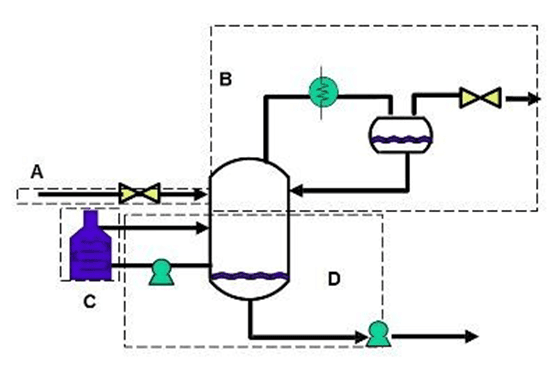
Next, the team finds and discusses all possible deviations from normal operation of technological nodes of the previously selected system. For each deviation, causes and consequences are determined and listed through ranking.
Risk ranking is used to assess consequences through impact on:
- human health and safety;
- production integrity;
- environment,
and based on recovery and repair costs.
Risk assessment serves to demonstrate risk acceptability and to support decisions on creating recommendations that reduce risks. Risk ranking prioritizes recommendations.
All discussion by the specialist group during the HAZOP session is recorded for further analysis or correction of possible errors.
In conclusion, a study report is prepared containing tables, data, conclusions, and developed recommendations. The report requires approval and subsequently obligates parties to implementation.
Main Stages and Methods of HAZOP Analysis
Hazard and operability study represents a structured collective process of detailing and identification and uses a qualitative approach.
The qualitative approach, unlike the quantitative one, requires less detail and ultimately saves time while adequately providing a basis for determining priorities for an inspection program considering risk factors.
As an example below (Fig.2) - HAZOP for oil and gas industry for hazards related to integrity of equipment operating under pressure.
The process of preparing and conducting hazard and operability analysis is carried out in accordance with GOST R 27.012-2019 recommendations and consists of stages indicated in Fig.2.
Stage 1 – Terms of Reference
Work begins with preparation of terms of reference by the Customer, describing: the object, purpose of conducting the risk session, defined boundaries and timeframes for HAZOP conduct.
Together with the terms of reference, the Customer provides a set of documents necessary for conducting the session of the studied object. Main list:
- Risk assessment matrix adopted in Customer's assets.
- Process flow diagrams (PFD);
- Piping and instrumentation diagrams (P&ID).
- Plant general layout.
- Process description (Technological regulations).
- Emergency response plan.
- "Cause-effect" table of safety system functions.
- Layout scheme of fire and gas detection sensors, fire suppression systems.
- Equipment and pipeline list with design parameters.
- List of technological blocks with explosion hazard category indication.
Stage 2 - Analysis of Received Data
After the Customer prepares necessary design documents, RBI Concept specialists conduct a review, checking their completeness and suitability for conducting HAZOP risk session, and if necessary, discuss with the Customer preparation of additional documents or clarifications.
Stage 3 - Project Division into Nodes and Preparation of Guide Words
After receiving all necessary information, for convenience of risk and operability assessment, the HAZOP chairman distributes the studied object into technological blocks (nodes) using process flow diagrams (PFD) and piping and instrumentation diagrams (P&ID).
For each technological block/node, a set of guide words is selected, such as: more, less, none, reverse, deviation, etc., and a set of parameter words, such as: pressure, flow, temperature, level, quality, etc., characterizing the process in this node.
Using combinations of guide words with parameter words, deviation modeling and node reaction are conducted, for example, pressure more/less, temperature more/less, etc.
At the stage of project division into nodes and guide word preparation, HAZOP working group formation is conducted. GOST R 27.012-2019 in section 6.2.3 indicates that study effectiveness depends on sufficient knowledge of the method by all working group members; otherwise, necessary training is organized.
The working group is formed from Customer and Contractor representatives and includes the following specialists:
- HAZOP Chairman.
- HAZOP Secretary.
- Lead process engineer.
- Equipment operation engineer.
- Design engineers.
- Instrumentation engineer.
- Safety engineer.
Chairman and secretary are provided by the Contractor. The rest of the team is assembled by the Customer.
Customer-delegated working group members take full participation in the risk session throughout its entire duration.
The working group may invite other specialists. For example, if complex rotating equipment is included in the assessment process, a mechanical equipment engineer is involved in the group work.
Stage 4 - Hazard and Operability Analysis
The working group conducts the analysis. The sequence of steps for conducting the risk session is indicated in Fig.3
Operability analysis begins with a brief explanation by the design organization representative of the process, which includes all operational aspects and detailed information about startup and shutdown procedures of the considered object.
For each of the identified nodes of the studied object, critical deviations and node reactions to them are simulated using parameter words. That is, the working group determines consequences of critical deviation impacts on the node, without considering existing protection measures.
The next step in the analysis process is risk determination using the risk matrix agreed with the Customer. After risk determination, the working group proceeds to assess existing protection measures. It evaluates whether they are sufficient to eliminate risk or reduce it to an acceptable level.
If existing safety measures are insufficient, the working group proposes additional protection measures in the form of recommendations that allow safe object operation.
All HAZOP analysis recommendations undergo collective verification and correction by the working group and are entered into session working tables considering their implementation criticality.
Based on the conducted HAZOP analysis results, the working group prepares a report including: explanatory note, session protocol tables, list of all issued recommendations considering their criticality.
Based on the HAZOP report with proposed recommendations, the Customer's technical director prepares an implementation plan indicating responsible parties and completion deadlines.
The working group is reconvened in full composition to review relevant P&ID sections if significant modifications were made to them after conducting the primary HAZOP study. If doubts arise regarding the significance of changes, a decision is made to conduct partial or completely new HAZOP study for this P&ID.